

Picture the best taco spot in Bakersfield. Great food, fair prices, a line out the door on weekends. Now picture it with no sign, no address on the door, and on a street nobody drives down. The tacos are still great. Nobody finds them.
That’s a business without SEO. Search engine optimization is everything that helps Google, and now AI assistants, understand what you do, trust you, and send people to your door.
I first wrote this guide in 2024. A lot has changed since then. Google now writes AI answers above the search results, people ask ChatGPT where to eat and who to call, and customers expect more from your reviews than ever. The good news: the foundations didn’t change. They just matter more.
What changed since 2024
- AI answers sit on top. Google’s AI Overviews summarize an answer before the links. In a Pew Research study, people clicked a regular result in 8% of visits when an AI summary appeared, versus 15% without one. Fewer clicks go around, so the ones left go to businesses Google trusts.
- People ask AI for recommendations. 45% of consumers used ChatGPT or another AI tool to find local businesses, up from 6% a year earlier (BrightLocal, 2026).
- Reviews have a shelf life. 74% of people only consider reviews from the last three months.
- “Google My Business” is now Google Business Profile. Same free listing, new name, and still the most important thing you own on Google.
- Speed is measured differently. Google’s responsiveness score is now INP (more on that below), which replaced the old one in March 2024.
Think of it as a building
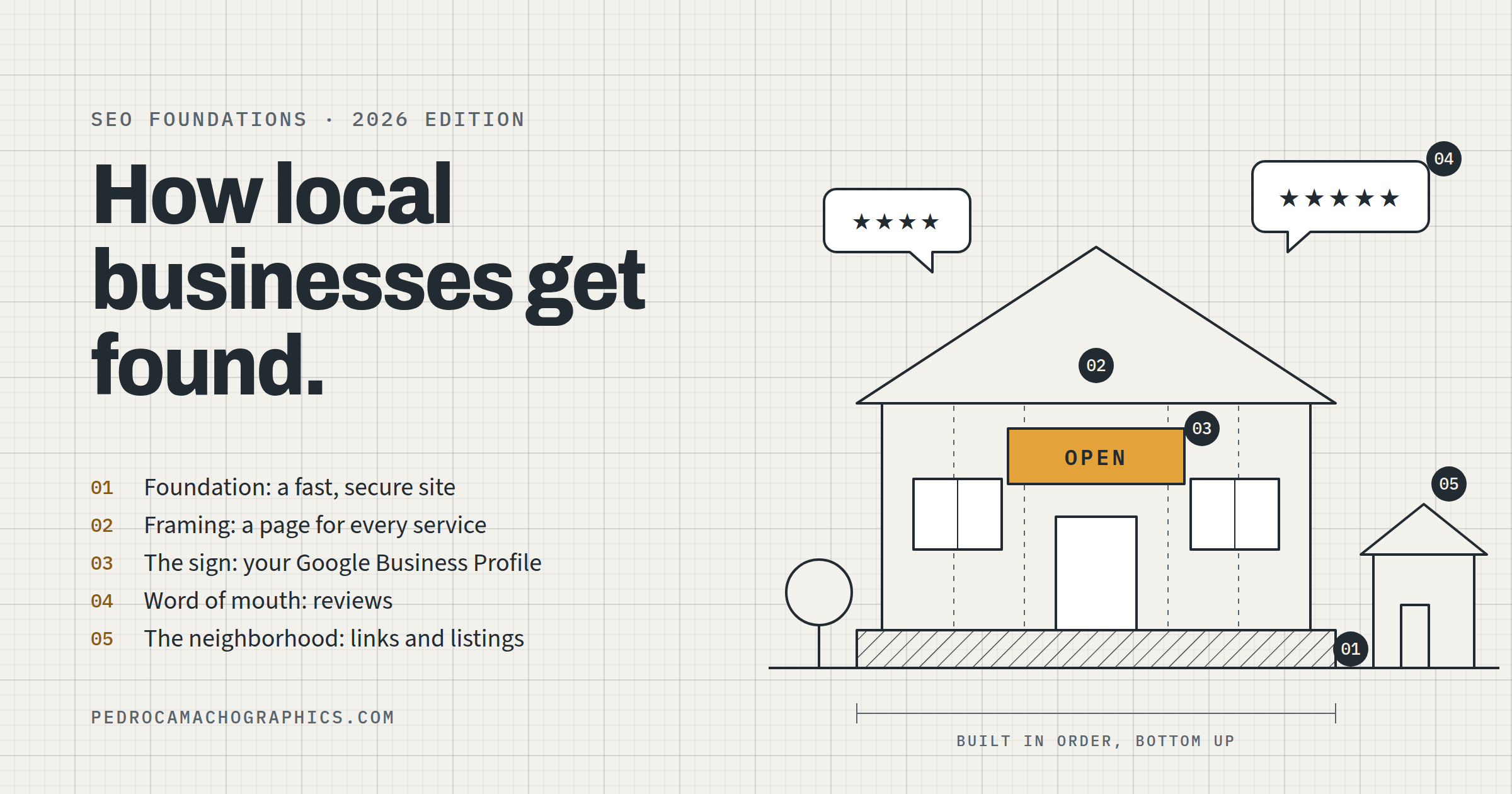
The drawing at the top of this post is the whole guide in one picture. You build a shop from the bottom up: a foundation, then the framing, then the sign out front. Word of mouth brings people in, and a good neighborhood brings in more. SEO works the same way, and in the same order. A beautiful sign on a cracked foundation still falls over.
Before we pour concrete, though, it helps to know how Google decides who gets seen.
How Google picks local businesses
Google is open about the basics. Its own help pages say local results are based mainly on three things:
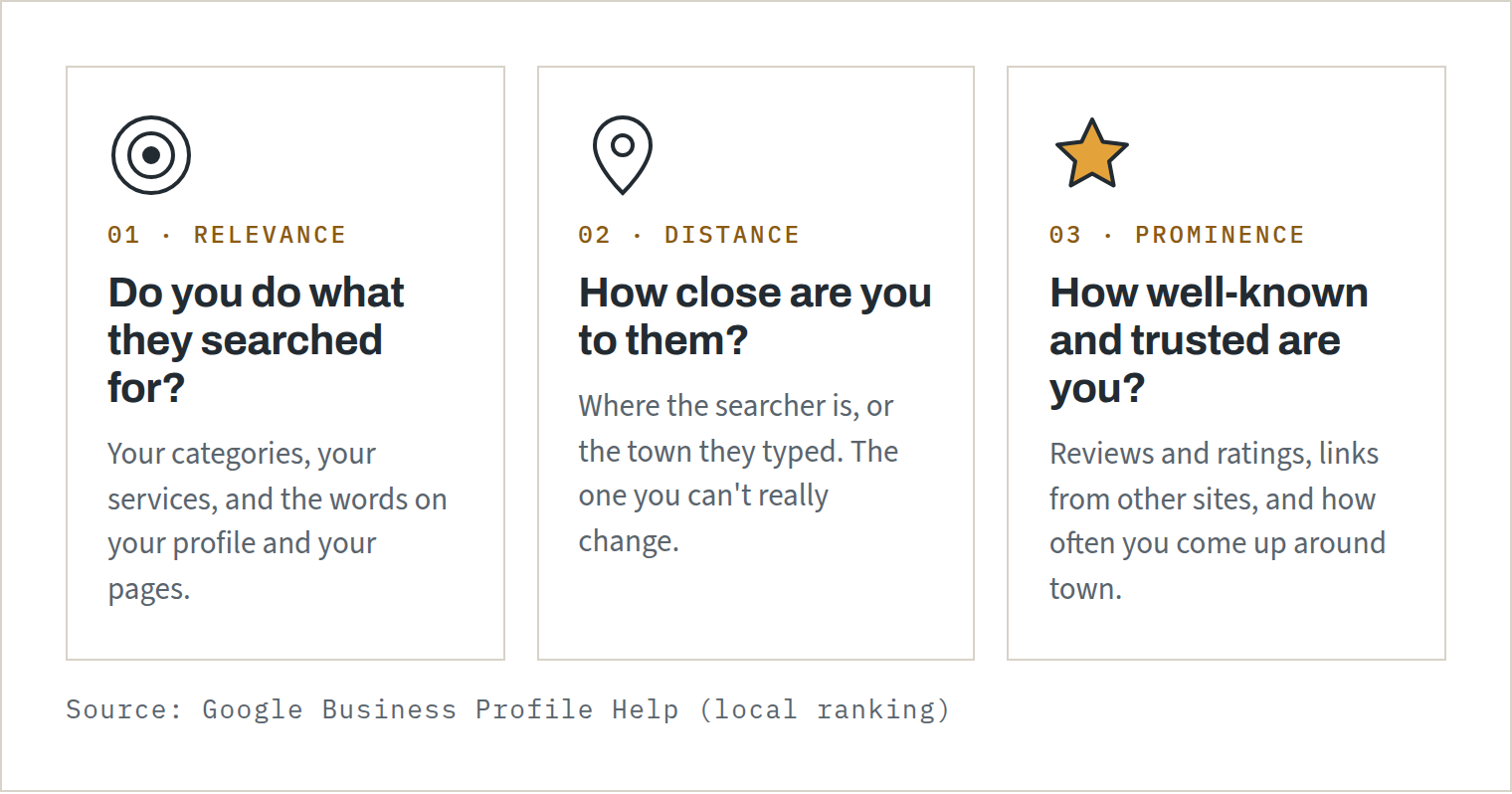
Think of Google as the friend everyone in town texts for a recommendation. Before it answers, it asks itself three questions: does this business actually do what they asked for (relevance), is it nearby (distance), and do people around here know and like it (prominence)? You can’t move your shop closer to every customer. You can make sure Google is never confused about the other two.
One more line from Google worth framing: “There’s no way to request or pay for a better local ranking on Google.” Anyone who promises a guaranteed #1 spot is selling something Google itself says doesn’t exist.
Those answers show up in three places on the page, like three shelves in a store:
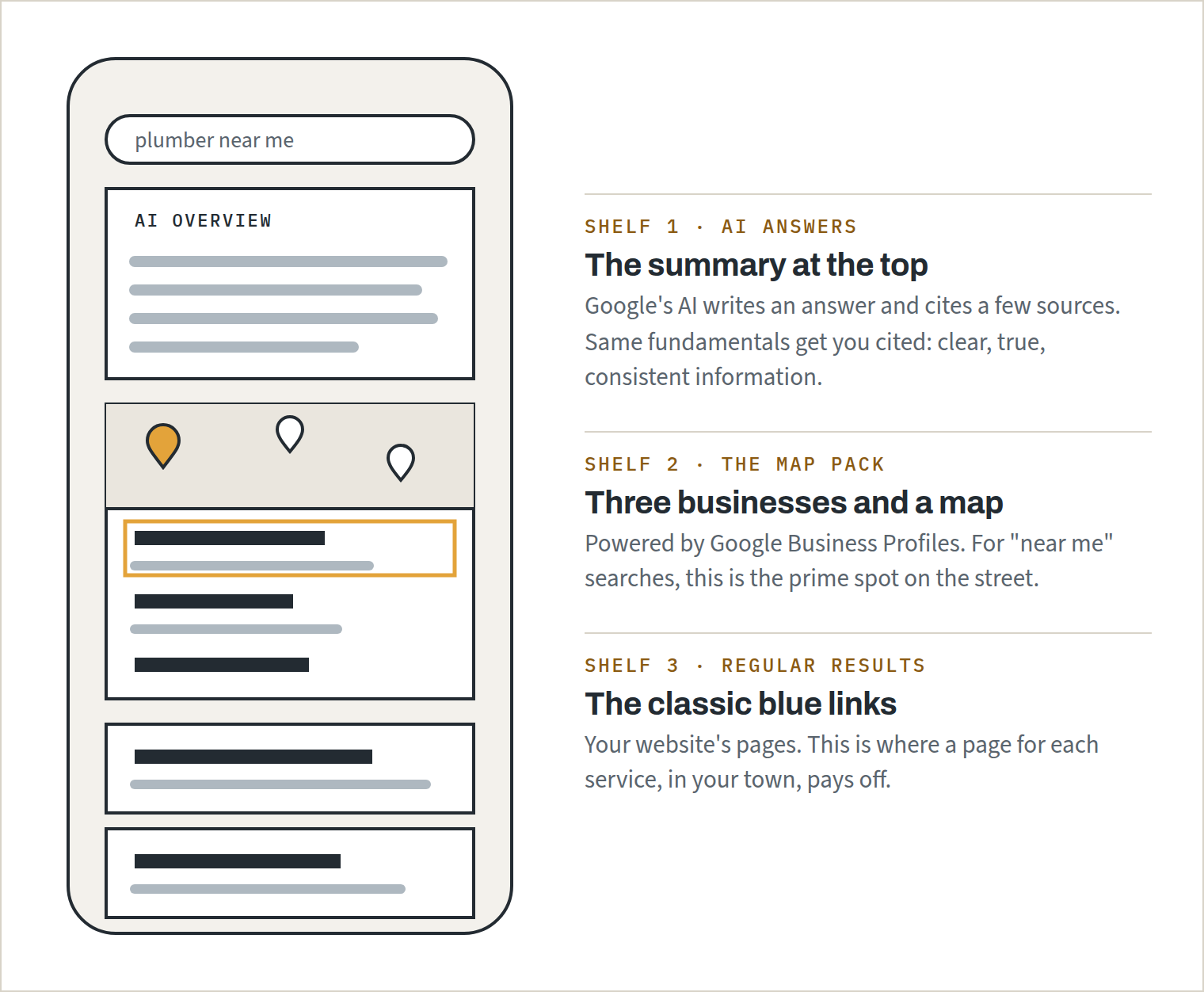
Each part of the building below helps with at least one shelf. Let’s build.
01 · Foundation: a fast, secure, findable site
Before Google can recommend you, its crawlers (think of them as building inspectors) have to get in the door, look around, and leave with good notes. That means:
- A secure site. Your address starts with
https://and browsers show no warnings. - A site built for phones first. Most local searches happen on a phone, often in a parking lot. If the “Call” button is hard to tap, the inspector notices, and so does the customer.
- Google Search Console set up. It’s free, and it’s the inspection report: which pages Google found, which searches you showed up for, and what’s broken. Submit your sitemap there so Google gets the full floor plan.
- Speed that passes the test. Google measures real visitors with three scores called Core Web Vitals:
| Score | What it measures, in plain English | Good is |
|---|---|---|
| LCP (Largest Contentful Paint) | How long until the main thing on the page shows up | 2.5 seconds or less |
| INP (Interaction to Next Paint) | How quickly the page reacts when someone taps or clicks | 200 milliseconds or less |
| CLS (Cumulative Layout Shift) | How much things jump around while the page loads | 0.1 or less |
A page passes when at least three out of four visits hit all three targets. To check yours, paste your address into Google’s free PageSpeed Insights and look at the mobile results. If you see red, the usual suspects are huge images, too many plugins, and cheap hosting.
02 · Framing: a page for every service
A shop with one big room and a sign that says “we do everything” makes customers guess. Google guesses too, and it usually guesses someone else.
In Whitespark’s 2026 Local Search Ranking Factors survey, where 47 local search experts scored 187 factors, the #1 factor for showing up in regular local results was simple: a dedicated page for each service. The same factor came in #2 for showing up in AI answers. A plumber with one page for water heater repair, one for drain cleaning and one for leak detection gives Google three clear rooms to send people to.
Start with the words your customers use
You might call it “HVAC service.” Your customers type “AC repair” at 2 p.m. in July. The old way to find these words was paid keyword tools, and they still help, but the free clues are right in front of you:
- Start typing your service into Google and read the suggestions it fills in.
- Look at the “People also ask” questions on the results page.
- In Search Console, look at the searches people already use to find you.
- Listen to the phone. The questions customers ask you every week are the questions they type into Google.
Label every room clearly
Each page has a few labels that Google reads first. Here’s the difference between a label that whispers and one that helps:
| Label | Weak | Strong |
|---|---|---|
| Title (the blue link in search) | Home | Water Heater Repair in Bakersfield | Valley Plumbing |
| Meta description (the gray text under it) | Welcome to our website! | Same-day water heater repair in Bakersfield and Oildale. Upfront prices, licensed techs. Call or book online. |
| Main heading (H1, the page’s headline) | Services | Water heater repair in Bakersfield |
| Image (file name and alt text) | IMG_4021.jpg, no description | water-heater-install.jpg, described as “New 50-gallon water heater installed in a garage” |
Note: “Valley Plumbing” is a made-up example. Google sometimes rewrites your title and description using text from the page, so the page itself has to say the same thing clearly. The labels are a strong hint, not a guarantee.
Then fill each room with what a customer actually wants to know: what’s included, what it usually costs, how long it takes, which neighborhoods you serve, and photos of real jobs. Plain answers to real questions are exactly what AI answers like to quote.
If you want extra credit, add LocalBusiness structured data, a small block of code that spells out your name, address, phone and hours for machines. Google’s rule: it has to match what’s visible on the page.
03 · The sign out front: your Google Business Profile
Your Google Business Profile is the sign, the hours on the door and the map pin, all in one. It powers the map pack, and it’s free. If you only do one thing from this guide, do this one.
- Claim and verify it. Verification tells Google you’re the real owner.
- Pick the most specific primary category. In the 2026 survey, the primary category was the #1 factor for the map pack. “Mexican restaurant” beats “Restaurant.” “Water heater installation service” might beat “Plumber,” if that’s your main work.
- Use your real business name. Only your real name. Keywords in the name do help rankings, which is exactly why people stuff them in. Google’s guidelines forbid it, and it can get your profile suspended. “Valley Plumbing” is fine. “Valley Plumbing Best Bakersfield Plumber 24/7” is a suspension waiting to happen.
- Keep your hours right, including holidays. Being open at the time of the search was a top-five map pack factor. A customer who drives over and finds the door locked on the Fourth of July doesn’t come back.
- Add photos and videos. Real ones: your team, your work, your storefront. Add new ones every month or two.
- Work from customers’ homes? If you’re a service-area business, hide your address and set your service area instead. Google’s guidelines require it.
While you’re at it, claim the same listing on Apple Business Connect (Apple Maps) and Bing Places. Both are free, and 27% of consumers now read reviews on Apple Maps, nearly double the year before.
04 · Word of mouth: reviews
Reviews are the neighbors talking over the fence, except now the fence is the size of the internet. And the neighbors have gotten picky:
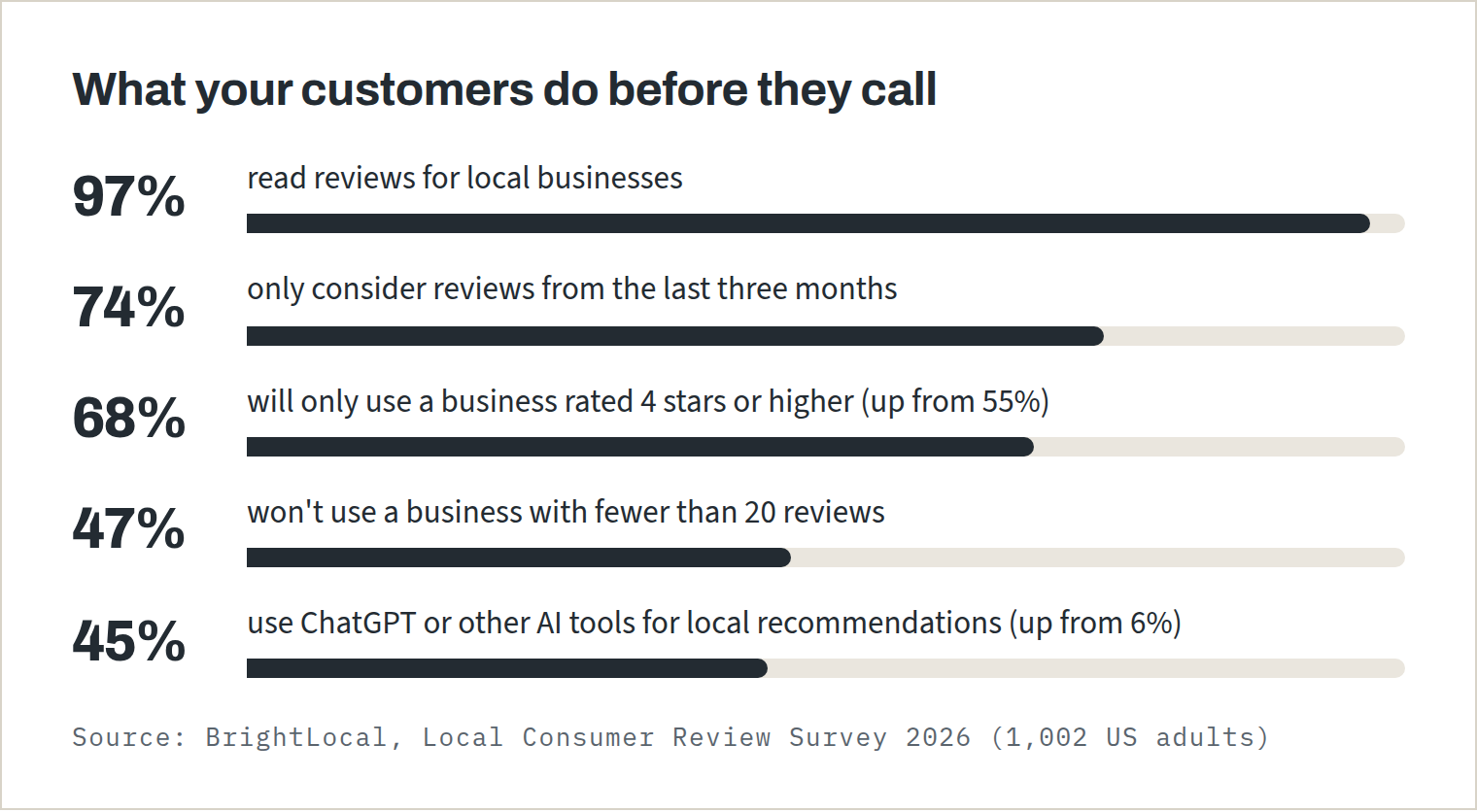
Freshness matters as much as the stars. A five-star review from 2022 is like a “best in town” award from three owners ago. Customers want to know what you’re like now. Google agrees: more reviews and positive ratings can help your local ranking, in its own words.
- Ask every customer, right after the job. Text them the direct review link from your Business Profile while the experience is fresh. A steady trickle beats a big burst once a year.
- Reply to every review, the good and the bad. Google recommends it, and future customers read your replies. A calm, helpful answer to a one-star review often wins more trust than the five-stars around it.
- Never buy, fake or trade reviews. Since October 2024, a Federal Trade Commission rule bans buying and selling fake reviews and lets the FTC seek civil penalties, and Google removes fake reviews it finds. It’s also just bad business: 97% of consumers say there should be consequences for it.
05 · The neighborhood: links, listings and mentions
A shop on a busy, well-known street gets more walk-ins than the same shop in an empty lot. Online, your neighborhood is every other website that mentions you.
- Keep your name, address and phone identical everywhere. Yelp, Facebook, the Better Business Bureau, industry directories, the chamber of commerce. “Suite 200” on one site and “#200” on another is fine. A phone number from two moves ago is not.
- Earn local links. A link from a Bakersfield site is a recommendation from the store next door. Sponsor a Little League team, join the chamber, partner with businesses you already work with, or give a local reporter a useful quote.
- Get on the “best of” lists. In the 2026 survey, the #1 factor for showing up in AI answers was being included on expert-curated “best of” lists. AI tools read those lists to decide who to recommend.
What about AI search?
Here’s the part a lot of people are selling as new and expensive. Google’s own documentation says it plainly: “There are no additional requirements to appear in AI Overviews or AI Mode, nor other special optimizations necessary.” It also says you don’t need special AI files or new markup.
Think of AI as a new receptionist who has read everything ever written about you: your website, your profile, your reviews, those “best of” lists. When someone asks for a recommendation, it repeats what it read. So the job is the same five steps, done consistently:
- Say the same thing everywhere: same name, same services, same areas.
- Answer real questions in plain language on your service pages.
- Keep reviews coming, so there’s always something recent to read.
- Show up on the lists and local sites that AI tools trust.
If someone offers to “optimize you for ChatGPT” with a secret technique, ask them which of the five steps they’re doing. If the answer is none, keep your money.
The toolbox
You don’t need a garage full of tools. Most of this is free:
| Tool | What it’s for | Cost |
|---|---|---|
| Google Business Profile | Your listing on Google Search and Maps | Free |
| Google Search Console | What Google sees on your site, and which searches find you | Free |
| PageSpeed Insights | Your Core Web Vitals scores, with fixes | Free |
| Apple Business Connect and Bing Places | Your listing on Apple Maps and Bing | Free |
| Google Keyword Planner | Search volume for the words customers use | Free with a Google Ads account |
| BrightLocal or Whitespark | Managing listings and tracking local rankings | Paid |
| Semrush or Ahrefs | Keyword research and what competitors rank for | Paid |
Your weekend checklist
Pick one free weekend morning and work down this list. Each item is small. Together they’re the whole foundation.
- Claim and verify your Google Business Profile.
- Set the most specific primary category, and add your holiday hours.
- Upload ten real photos: your team, your work, your storefront.
- Text five recent customers your review link.
- Reply to every review you haven’t answered yet.
- Make sure each main service has its own page.
- Rewrite your homepage title so it says what you do and where.
- Run your site through PageSpeed Insights on mobile.
- Set up Search Console and submit your sitemap.
- Check that your name, address and phone match on Yelp, Facebook, Apple Maps and Bing.
Built to last
SEO isn’t a trick you do once. It’s a building you keep up. Fix what cracks, freshen what fades, add a room when you add a service. The businesses that win local search aren’t the ones with a secret. They’re the ones that keep showing up, online and in person.
If you’d rather have someone build the foundation with you, that’s what I do: websites built for search from the first line of code, with the care to keep them that way. Tell me about your business and I’ll tell you honestly where to start.
Sources
- Google Business Profile Help: Tips to improve your local ranking on Google
- Google Business Profile Help: Guidelines for representing your business on Google
- Google Search Central: AI features and your website
- web.dev: Web Vitals
- Whitespark: 2026 Local Search Ranking Factors
- BrightLocal: Local Consumer Review Survey 2026
- Pew Research Center: Google users are less likely to click on links when an AI summary appears (2025)
- FTC: Final rule banning fake reviews and testimonials (2024)